Do Plug-In Energy Savers Cut Bills? How to Spot Unsafe Power-Saving Gadgets
Smart Home DIY
Quick Summary
A small box plugged into one wall socket cannot meaningfully reduce the electricity billed to an ordinary UK home merely by “stabilising voltage”, “balancing current”, “cleaning dirty electricity” or correcting power factor. Domestic customers are normally charged for real energy in kilowatt-hours. A mystery device that contains no controllable connection to your appliances cannot make a kettle, heater, tumble dryer or gaming PC perform the same work while drawing dramatically less real energy.
This is not only a question of disappointing savings. In October 2026, Electrical Safety First reported that all 13 marketplace energy-saving devices it tested failed basic safety checks, none could deliver the advertised savings and two exploded during laboratory testing. If you own one, unplug it if this can be done safely, stop using it and follow the reporting and disposal guidance below. To reduce bills, measure actual loads, change schedules or settings, repair genuine faults and replace equipment only when the numbers justify it.
Why these gadgets are appearing again in autumn 2026
Higher bills create ideal conditions for products that promise a painless technical shortcut. Ofgem’s price cap for a typical dual-fuel household paying by direct debit rose from an illustrative £1,663 a year to £1,723 for the period beginning 1 October 2026. That figure is not a household spending limit, and your bill still depends on the energy you use, but the increase puts electricity costs back into search results, social feeds and family conversations.
Marketplace adverts exploit that attention with a simple story: plug a tiny box into a socket, leave every appliance operating as before and watch the bill fall by 20%, 30% or even 50%. The box may have a glowing green LED, an impressive electrical-sounding name and a cutaway graphic showing coils or capacitors. Testimonials often describe immediate savings without showing meter readings, tariff rates, weather, occupancy or any other evidence needed to make the comparison useful.
The timing matters because people searching under financial pressure are more likely to accept a product that appears cheap, effortless and reversible. A £10 or £20 gadget feels less risky than changing a tariff, adjusting heating controls or measuring appliances for a week. Unfortunately, the low purchase price does not make an unsafe mains-powered box harmless. The sensible response is not to become suspicious of every energy monitor or smart plug. It is to separate devices that measure or control electricity from devices that claim to save it by unexplained magic.
What the bogus boxes usually claim to do
The wording varies, but common claims include voltage stabilisation, current balancing, surge suppression, power-factor correction, phase correction, removal of electrical noise and “optimisation” of the home supply. Some listings imply that electricity currently leaks uselessly through the wiring and that plugging the box into a socket near the meter will capture or recycle it. Others use an animation in which a jagged waveform becomes smooth after passing through the product.
These phrases borrow fragments from real electrical engineering. Power-factor correction matters in some industrial systems. Surge protection is a real function when a properly designed protective device is installed and rated for the job. Voltage regulation is useful in suitable equipment. Filtering can reduce interference in particular circuits. The deception is the leap from “this concept exists” to “this tiny consumer box will cut a normal domestic electricity bill while everything else behaves identically”.
A legitimate device should state a specific function, electrical rating, applicable standard, manufacturer or responsible UK economic operator, instructions, limitations and a traceable model number. Its benefit should be testable. A plug-in energy monitor displays how much a connected appliance uses. A smart plug can switch an appropriate load off on a schedule. A thermostat can reduce boiler runtime by changing control behaviour. A mystery saver commonly offers no credible mechanism, no useful controls and no before-and-after measurement beyond the advert’s own numbers.
Why a plug-in box cannot erase normal household energy use
Your electricity meter records energy over time. A 2kW heater running for one hour uses roughly 2kWh because electrical energy is being converted into heat. A kettle needs energy to raise the temperature of its water. A computer needs energy to operate its processors, storage, display and cooling. If those devices perform the same work for the same duration at the same efficiency, another box elsewhere in the house cannot simply make a large fraction of their real energy disappear.
Some scam listings focus on power factor. In simplified terms, alternating-current equipment can draw current that is not perfectly aligned with voltage. Commercial and industrial billing arrangements may account for poor power factor because it increases current in the supply system. Ordinary UK domestic customers, however, are generally billed for real energy in kilowatt-hours rather than being charged an industrial-style penalty that a socket-level capacitor could remove. Even if a box slightly changed local power factor, that does not support the advertised household bill reductions.
There is also a basic scale problem. A home may simultaneously power a kettle, oven, washing machine, television, lighting, computers, pumps and chargers across several circuits. A small device connected to one socket is not wired in series with those appliances and does not control their operation. If it consumes any power itself, its LED and internal components may actually add a tiny amount to usage. The amount is small, but “adds a little while saving nothing” is not the bargain advertised.
Do not try to prove this by opening a suspicious mains device. Internal photographs online may show little more than an LED circuit and a capacitor, but construction varies and a badly designed unit may retain charge, expose live parts or use inadequate insulation. The absence of a useful function does not imply the absence of dangerous voltage.
The October safety warning is stronger than “probably ineffective”
Electrical Safety First’s October 2026 investigation purchased 13 devices sold through AliExpress, Amazon Marketplace and TikTok Shop. The charity reported that every device failed basic safety testing, none contained components capable of delivering the claimed energy savings and two exploded during a laboratory test. Reported defects included inadequate insulation and components that could fail dangerously.
That does not prove every visually similar item has identical construction. It does establish that the category deserves more than a shrug about wasted money. Marketplace availability, customer ratings and a familiar fulfilment interface are not substitutes for a trustworthy manufacturer, compliant design and meaningful technical documentation. A seller can disappear, rename an item or relist it under another brand while retaining the same casing and claims.
Be particularly cautious when the listing uses several unrelated brand names, has no manufacturer website, provides no downloadable manual, displays safety marks only in edited product images, or gives no UK contact responsible for compliance. A CE or UKCA logo printed on a casing is a claim, not independent proof. Spelling mistakes are a clue, but polished copy is not proof of safety either. Scam products have discovered grammar; civilisation continues to decline in inventive ways.
Seven warning signs before you buy
- Large percentage savings with no conditions: Real savings depend on the appliance, usage pattern, tariff and behaviour. A fixed “up to 50%” claim applying to every home is not credible evidence.
- No load is measured or controlled: If the device neither measures individual appliances nor switches them, ask what observable action could cause the saving.
- Engineering words without specifications: “Stabilises current” means little without a circuit description, operating range, rated capacity, standards and test evidence.
- A diagram instead of data: Animations of smooth waves, green arrows and coins are marketing. Look for repeatable measurements from a competent, independent source.
- Generic casing under many brands: Search the product image or exact claim. Identical devices with changing names and implausibly different specifications are a warning.
- Ratings discuss delivery rather than results: Reviews written immediately after arrival cannot establish a change in a quarterly bill. Weather and heating use can overwhelm any casual comparison.
- No responsible company to contact: A traceable manufacturer, model, postal address, instructions and warranty do not guarantee quality, but their absence makes accountability difficult.
If you already have one plugged in
Do not panic, and do not dismantle it. If the device, plug or socket is hot, discoloured, buzzing, crackling, smoking or giving off a chemical or burning smell, avoid touching it, switch off the relevant circuit if you can do so safely and seek help from a competent electrician or the emergency services as appropriate. A product that is actively overheating is not the moment for a teardown video.
If there are no signs of immediate danger, switch the socket off before removing the device. Keep photographs of the product, packaging, listing, order number and seller details. Contact the marketplace and request a return or refund. Report a suspected unsafe product through the marketplace and the relevant UK product-safety route. Electrical Safety First also provides consumer guidance, and Citizens Advice can direct reports to Trading Standards.
Do not pass the device to a friend, donate it or place it in a drawer for future experimentation. Treat it as electrical waste and use an appropriate WEEE collection point or retailer take-back route. If a marketplace requests the product back, follow its instructions only where they do not require you to reconnect or test an item you believe may be unsafe.
Measure first: a safer route to genuine savings
Begin with your electricity meter, smart-meter in-home display or supplier data. Record a normal week rather than one unusually quiet afternoon. Look for the household baseline overnight and while people are out. Then note the large, repeated loads: electric heating, immersion heaters, tumble dryers, ovens, dehumidifiers, gaming computers, servers, pumps and older refrigeration. The target is not the device with the smallest glowing LED. It is the avoidable use with enough wattage and runtime to matter.
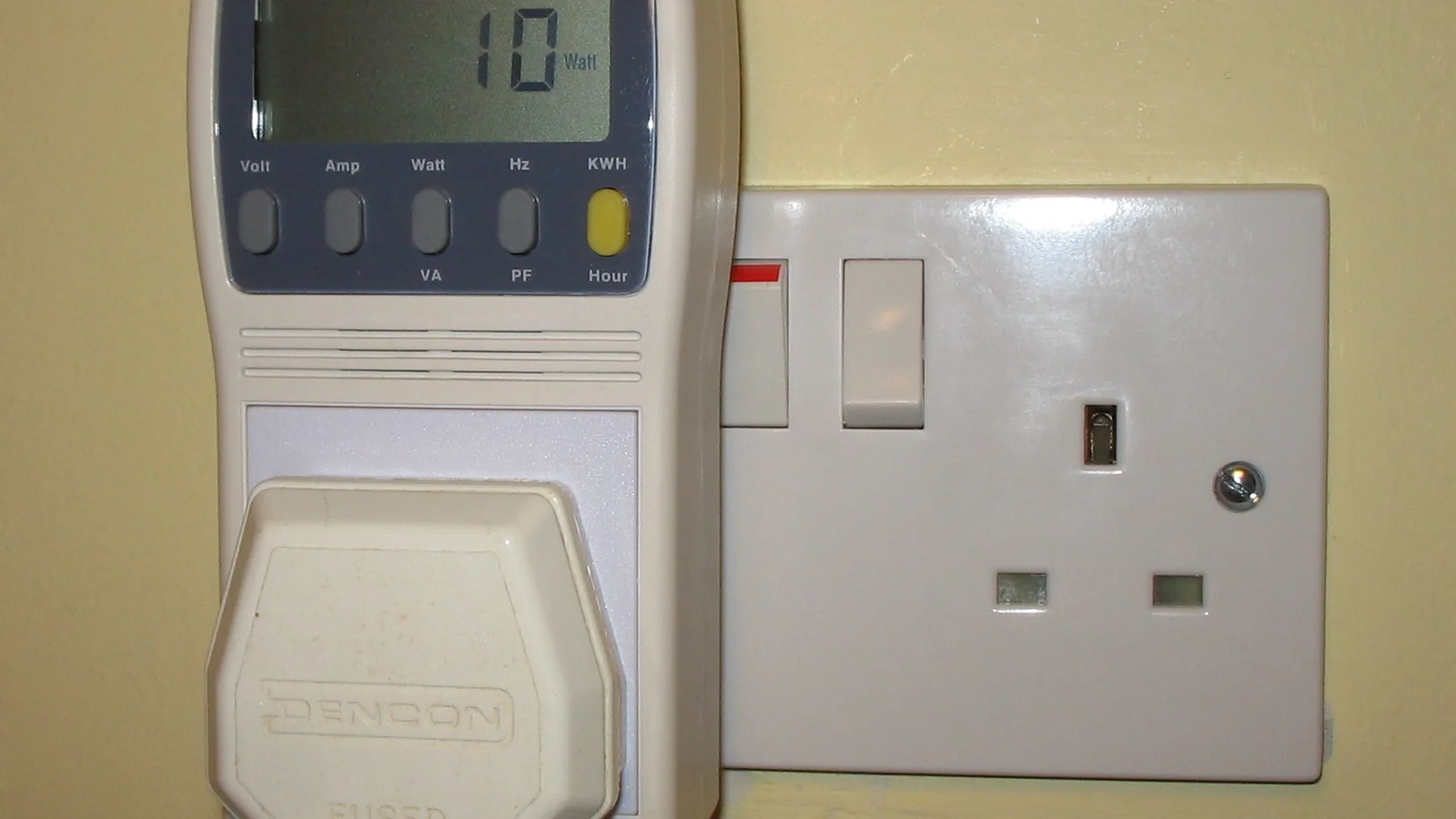
For a single suitable appliance, a real plug-in meter or energy-monitoring smart plug can show watts and accumulated kilowatt-hours. The existing DigiTech catalogue includes the TP-Link Tapo P110 energy-monitoring smart plug as one checked example for compatible low-to-moderate household loads. Confirm the plug’s rating and the appliance manufacturer’s guidance, keep within the permitted load, and do not use a general smart plug for unsuitable heating, motor or safety-critical equipment merely because the app has a pleasing graph.
Run the measurement long enough to capture the appliance’s cycle. Ten minutes may be useful for a steady desk setup but misleading for a fridge, freezer, dehumidifier or washing machine. Record both power and duration. A device drawing 100W for ten hours uses 1kWh; one drawing 2,000W for ten minutes uses about 0.33kWh. High power attracts attention, but runtime determines the energy total.
Change one thing and measure again. Disable an unnecessary always-on setting, shorten a schedule, lower a screen’s excessive brightness, use a computer’s sleep mode, clean a blocked filter or move a thermostat away from a heat source. Keep changes that reduce measured use without creating damp, discomfort, food-safety risks, lost recordings, frozen pipes or daily arguments about who unplugged the router.
Turn watts into pounds before buying an upgrade
The basic calculation is straightforward:
Energy used (kWh) = power (kW) × time (hours)
Cost = energy used (kWh) × tariff unit rate
Suppose an older desk setup averages 120W when nobody is using it and remains in that state for 12 unnecessary hours each day. That is 0.12kW × 12 hours = 1.44kWh per day. At an example rate of 25p per kWh, it costs about 36p a day, or roughly £131 over a year if the pattern never changes. If proper sleep settings reduce the idle period to 10W, the saving could be worth pursuing.
Now compare a 1W indicator left on continuously. It uses about 8.76kWh a year, costing roughly £2.19 at the same example rate. Turning it off is fine if convenient, but buying a £20 gadget to eliminate that load creates a long payback and another device to power. Measure scale before spending. Tiny savings remain tiny even when an advert photographs them beside a lightning bolt.
Use the unit rate from your own tariff, including different day and night rates where applicable. Standing charges do not disappear when you unplug an appliance, so do not include them as a saving. If an upgrade has an embodied cost and the existing device still works safely, compare the purchase price with realistic annual savings rather than assuming “efficient” automatically means “cheaper this year”.
Where real household electricity savings normally come from
- Reducing electric heat runtime: Fix schedules, thermostats, draughts and controls before buying decorative optimisation boxes. Electric resistance heating is a large load, so careful changes can matter.
- Finding devices that never sleep: PCs, monitors, consoles, amplifiers and printers can remain in active idle states because of settings, network wake features or connected accessories.
- Maintaining equipment: Blocked filters, iced-up freezers, failing door seals and poorly placed thermostats can extend runtime. Repair may beat replacement.
- Shifting flexible loads: Time-of-use tariffs can reward running appropriate appliances at cheaper periods, but only when the tariff and household pattern genuinely fit.
- Replacing proven heavy users: An inefficient appliance used frequently can justify replacement. Confirm the existing consumption first and calculate a realistic payback.
- Removing accidental operation: Immersion heaters, towel rails, outdoor lights, pumps and dehumidifiers sometimes run for far longer than intended because a timer, sensor or override was misunderstood.
For a structured room-by-room process, use the DigiTech guide to finding energy vampires with measured smart-plug data. If heating is the concern, complete the checks in Will a Smart Thermostat Cut Your UK Heating Bill? before purchasing a new control system. The common principle is evidence first, product second.
A ten-minute credibility check for any energy-saving gadget
- Write down exactly what the product claims to change: power, runtime, temperature, schedule, tariff timing or something else.
- Identify what it measures and what it controls. If the answer is “nothing visible”, demand much stronger evidence.
- Check the rated voltage, current, load type, standards, manufacturer, UK contact, manual and warranty.
- Search the exact model and product image outside the marketplace. Look for safety notices, identical rebrands and competent independent testing.
- Reject savings percentages that lack a baseline, measurement period, tariff, household conditions and test method.
- Calculate the maximum plausible saving from the load involved. A 3W device cannot remove £200 of annual usage unless it changes another substantial load.
- Ask whether a setting, timer, repair or behaviour change would solve the same problem without adding another mains-powered object.
This check also works for legitimate products whose marketing has become overexcited. A smart plug may measure and schedule a lamp perfectly while saving almost nothing because the lamp already uses little energy. A monitor can provide excellent data without saving a penny by itself. Tools create visibility and control; households still have to make a worthwhile change.
Related DigiTech guides
Final verdict
Do not buy a plug-in energy-saving box that promises large whole-home bill reductions without measuring or controlling a meaningful load. The domestic billing model does not support the usual power-factor story, the claimed mechanism is commonly vague, and the latest UK safety testing found failures serious enough to include explosions.
Use your meter data to find where energy is actually going. Measure suitable appliances, calculate cost from watts and runtime, then change a schedule, setting, fault or genuinely inefficient device. The boring method has fewer glowing LEDs, but it has one decisive advantage: the saving can be demonstrated before anyone asks you to believe the box is balancing quantum voltage through a green light.
Review freshness
Last reviewed: 16 October 2026
Update cadence: Review when UK electrical-product safety guidance, energy tariffs, marketplace enforcement or domestic metering rules materially change.