Lower Boiler Flow Temperature Safely: A 7-Day Smart-Meter Test
Smart Home DIY
Quick Summary
Lowering the central-heating flow temperature can help a suitable condensing combi boiler recover more heat instead of sending it out through the flue. The useful question is not whether everybody should copy one magic number. It is whether your boiler, radiators, controls and building can still bring occupied rooms to their target temperature reliably at a lower setting.
This guide turns that decision into a seven-day test. First confirm that you have a combi boiler without a separate hot-water cylinder. Record the current heating-flow setting, thermostat schedule, room temperatures, outdoor conditions and gas use. Lower only the radiator or central-heating flow setting by a small step, then leave the room target, hot-water control and thermostatic radiator valves alone. Watch comfort and warm-up performance before comparing energy use. If the system type is unclear, rooms already struggle, someone vulnerable depends on stable heat, or the boiler behaves abnormally, restore the original setting and use a Gas Safe registered engineer.
Why this is worth testing now
UK heating advice has become unusually specific this autumn. On 22 October 2026, Nesta said around 7.5 million UK homes could potentially reduce gas use by changing the flow temperature of a suitable combi boiler, estimating an average saving of about £57 a year for those households. The seasonal timing is obvious: clocks have gone back, colder weather has arrived and boilers that slept through summer are returning to daily service.
The headline is useful, but it can be misread as “turn every boiler to 60°C”. Homes are not test chambers. Radiator size, insulation, balancing, weather, occupancy, thermostat placement, boiler modulation and the difference between a combi and a cylinder system all matter. A setting that works in a modern insulated flat may leave the coldest room of a draughty house below target. A person with a combi may have separate controls for heating and tap water; another household may have a hot-water cylinder whose safe operation must not be guessed from a social-media post.
The better DIY-tech approach is measurement. Your smart thermostat can show calls for heat, room temperature and schedule behaviour. A smart meter or supplier portal can show gas consumption. A cheap room thermometer can expose a cold bedroom that the hallway thermostat never sees. None of these instruments automatically proves causation, but together they can show whether a lower setting still does the required job.
First identify the four controls people keep mixing up
| Control | What it changes | What it does not prove |
|---|---|---|
| Room thermostat | The target air temperature for the measured room or zone | It does not directly set radiator-water temperature. |
| Boiler central-heating flow temperature | How hot the water leaves the boiler for the radiators | It does not set the final room temperature by itself. |
| Boiler domestic-hot-water setting | Tap-water temperature on a combi with separate controls | It is not the setting this test asks you to reduce. |
| Thermostatic radiator valve | How much hot water enters one radiator as that room warms | Numbers such as 2, 3 or 4 are not boiler-flow temperatures. |
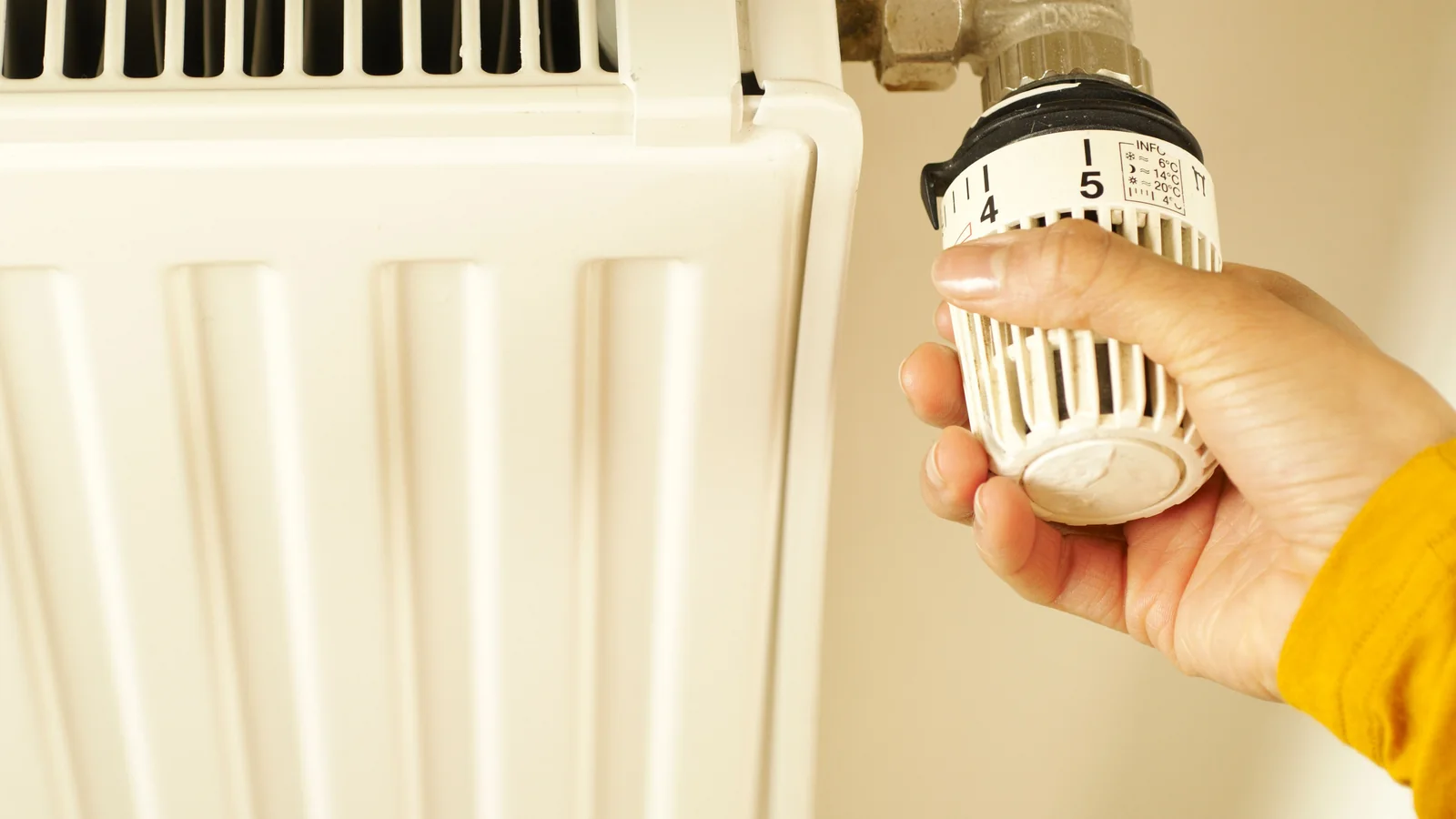
The hero photograph shows a thermostatic radiator valve, or TRV. It is deliberately not a picture of a boiler dial. The most common mistake in this subject is adjusting several controls and then claiming that one of them saved energy. If you turn down the room thermostat, close three TRVs, shorten the schedule and reduce boiler flow on the same evening, you have no clean way to tell which change caused a lower gas reading or a colder bedroom.
A good test changes one variable. Keep the desired room temperature the same. Keep the occupied schedule the same. Leave hot-water behaviour alone. Do not rebalance the entire radiator circuit halfway through. Reduce only the central-heating flow temperature, then observe whether the heating system still reaches the same comfort target.
Safety gate: when this guide is not the right instruction
This workflow is intended for a householder adjusting an exposed user control on a suitable condensing combi boiler. It is not permission to remove a boiler cover, alter combustion settings, change installer menus you do not understand, work on gas components or override safety controls. Use a Gas Safe registered engineer for gas work, internal boiler work, persistent faults or system changes.
- Stop if you have a hot-water cylinder: a system or regular boiler may use the same primary water to heat a stored cylinder. Stored-hot-water hygiene and cylinder-control requirements are different. Do not copy combi-boiler advice.
- Stop if you cannot identify the heating control: radiator and tap symbols vary, menus may be translated badly and some smart controls set a maximum flow temperature elsewhere.
- Stop if the boiler shows a fault: low pressure, repeated lockouts, unusual noise, leaks, fumes, scorching, burning smells or a carbon-monoxide alarm are not optimisation opportunities.
- Stop if reliable heat is safety-critical: households with babies, older people, vulnerable occupants or health conditions should prioritise stable comfort and seek tailored advice.
- Stop if rooms already fail to reach target: lowering output before fixing trapped air, poor balancing, undersized radiators, insulation gaps or a bad thermostat location can make an existing problem worse.
- Stop if a manufacturer or engineer has specified a setting: commissioned systems, weather compensation, OpenTherm control, underfloor heating and mixed-temperature circuits may already manage flow dynamically.
The Energy Saving Trust's current guidance also distinguishes suitable combi boilers from systems with hot-water cylinders and recommends gradual adjustment rather than a reckless dive to the lowest number visible.
What lower flow temperature is trying to achieve
A condensing boiler can recover additional heat from water vapour in its combustion products. It does that most effectively when the water returning from the radiators is cool enough to encourage condensation inside the designed heat exchanger. Running very hot water through the radiators can raise return temperature and reduce the time spent in efficient condensing operation.
Lowering the outgoing heating-water temperature can therefore improve efficiency, but there is a trade-off. Cooler radiators release heat more slowly. If the radiators are large enough for the room and the house does not lose heat too quickly, the system can run longer and more steadily while still reaching the thermostat target. If the radiators are marginal or the building leaks heat rapidly, the coldest room may never catch up during severe weather.
This is why radiator feel is a poor judge. A radiator at a lower flow temperature may feel merely warm instead of aggressively hot while the room remains comfortable. That can be a successful result. Conversely, a scorching radiator does not prove that the boiler is economical; it proves that the metal is scorching. Judge the room temperature, warm-up time, boiler behaviour and energy use.
Build a clean baseline before touching the setting
Use at least one normal heating day before the change. Three similar days are better if weather allows. Record the information in a note, spreadsheet or home-automation dashboard, but do not turn data collection into a month-long infrastructure programme. The boiler will not become more efficient because you deployed Prometheus at it.
- Photograph the current boiler display or dial. Capture the central-heating setting and any radiator symbol. This gives you a reliable rollback point.
- Record the system type. Note the boiler make and model, whether there is a hot-water cylinder, and whether a smart thermostat uses on/off control, load compensation, weather compensation or OpenTherm.
- Freeze the thermostat plan. Write down the target temperatures and occupied periods. Disable temporary experiments such as an unusually long boost.
- Choose two or three rooms. Include the thermostat room, the slowest occupied room and a room that normally behaves well. Place thermometers away from radiators, windows, direct sun and electronics.
- Record the starting indoor temperature. A system recovering from 14°C has a different job from maintaining 19°C.
- Note outdoor conditions. Use a local weather record or an outdoor sensor. Wind, rain and temperature materially change heat loss.
- Capture gas use. Use the meter, in-home display or supplier portal. Prefer kWh where available rather than cost, because tariffs and standing charges obscure the physical result.
- Note hot-water demand. Long showers, baths and guests can raise gas use without saying anything about space-heating efficiency.
Smart-meter data is often delayed or grouped into half-hour intervals. Treat it as trend evidence, not a laboratory instrument. If the supplier portal updates tomorrow, keep the test log and fill in the number later. Do not compare Monday's raw gas total with Tuesday's total if Monday was mild and empty while Tuesday involved freezing wind, two baths and somebody working from home.
The seven-day test
Day 0: make one cautious change
When you have confirmed a suitable combi system and identified the central-heating flow control, reduce it by a small step. If it is currently very high, 60°C is a commonly promoted starting point for suitable combis, but it is not a universal command. A five-degree step can be easier to evaluate in a difficult house. Leave the domestic-hot-water setting alone. Leave the room thermostat at the normal target.
Days 1 and 2: watch comfort before chasing savings
Check whether the measured rooms reach their target during ordinary occupied periods. Record the time at which heating starts, the starting temperature and the time each room reaches target. Expect radiators to feel cooler and warm-up to take longer. That is not automatically a fault. Failure means an occupied room consistently remains below the required temperature, recovery becomes impractically slow or the boiler begins behaving abnormally.
Days 3 and 4: inspect the control pattern
Use the smart-thermostat history if available. A lower flow temperature may produce a longer, steadier call for heat rather than short bursts. Look for repeated rapid cycling, overshoot, large room-to-room differences or a boiler that appears unable to modulate sensibly. App graphs can help, but remember that many thermostats record requested heat, not actual burner output.
Days 5 and 6: compare energy with context
Review daily gas kWh alongside outdoor temperature, wind, occupancy and hot-water use. Do not claim a precise saving from one warm day. Look for a direction: similar comfort, similar conditions and less gas is encouraging. Similar gas with steadier comfort may still be worthwhile. More gas or failed comfort needs investigation before another reduction.
Day 7: choose a result
- Keep it: all required rooms reach target, comfort is stable and the heating pattern is acceptable.
- Raise it slightly: most rooms work but the coldest occupied room misses target during colder periods.
- Restore the baseline: comfort is unreliable, faults appear or the system type was misunderstood.
- Fix the system first: one radiator is cold at the top, another steals all the flow, pressure falls, or thermostat placement clearly distorts control.
A simple results table
| Evidence | Likely meaning | Next action |
|---|---|---|
| Rooms reach the same target, radiators feel cooler, boiler runs longer | The lower setting may be working as intended | Keep it and review during colder weather. |
| Thermostat room reaches target but one bedroom stays cold | Distribution, radiator sizing or balancing may be the limit | Check that room before lowering flow again. |
| House overshoots less and temperature looks steadier | Gentler heat delivery may suit the building | Keep the schedule stable and collect more data. |
| Gas use falls on a much warmer day | Weather may explain the change | Do not publish yourself a victory parade yet; compare similar days. |
| Gas use rises after longer showers or guests | Domestic hot water contaminated the comparison | Separate heating conclusions from total-gas noise. |
| Boiler cycles rapidly or faults | The system needs diagnosis, not further experimentation | Restore the baseline and seek qualified help. |
| Flow setting changes itself | Smart modulation or weather compensation may be active | Read the control documentation before overriding anything. |
Why smart-home data can lie to you
Connected controls are useful because they preserve history, not because every graph is accurate. A thermostat mounted in a warm hallway may report success while a north-facing bedroom remains cold. A TRV may report its own casing temperature, warmed by the radiator, rather than representative room air. A supplier app may estimate gas use before the meter sends a confirmed read. A boiler integration may expose a requested target rather than measured water temperature.
Cross-check important conclusions. Use a separate thermometer in the problem room. Compare the gas meter's physical reading with the app over a longer period. Watch whether the boiler burner icon corresponds with the thermostat's call-for-heat graph. If Home Assistant or another platform records the data, label sensors clearly and retain the original units. “Heating temperature” is a dangerous entity name when it could mean room set point, radiator valve target, boiler flow, return temperature or hot water.
Also avoid cost-only comparisons. Smart displays convert consumption into pounds using tariff data that may be stale, averaged or missing. Kilowatt-hours tell you how much gas was used. Cost matters for the bill, but kWh is cleaner for judging the physical effect of one heating change.
Common mistakes that invalidate the test
- Changing the wrong dial: reducing tap-water temperature instead of central-heating flow.
- Copying a stranger's lowest number: their radiators, insulation, climate and controls are not yours.
- Turning every TRV down as well: lower room demand can reduce gas, but it no longer isolates flow temperature.
- Judging after one hour: the whole point is that gentler heating can take longer.
- Comparing unlike days: a ten-degree outdoor swing overwhelms a small efficiency change.
- Ignoring hot water: baths and showers share the gas meter with heating in a combi home.
- Entering hidden installer menus: user flow control is one thing; altering combustion or commissioning parameters is another.
- Forgetting the rollback value: always photograph or write down the original setting.
- Optimising past comfort: a cold home is not an efficiency achievement.
If the lower setting fails, diagnose before buying gadgets
A failed test can reveal useful information. If one radiator is cold at the top, it may contain air. If it is warm at the top but cold across the bottom, sludge may be involved. If the nearest radiators become hot quickly while distant rooms lag, balancing may be poor. If the thermostat sits beside a radiator, in sun or in a draught, it may stop or start the system at the wrong time. If every room struggles, heat loss or radiator capacity may be the limiting factor.
Do not assume a smart thermostat, smart TRV bundle or new boiler is the first answer. Start with maintenance, control placement and evidence. Our guides to making a smart thermostat read the right temperature, setting up smart radiator valves without creating cold rooms and checking whether a smart thermostat will actually cut your bill cover those separate decisions.
Final decision: keep the lowest setting that reliably heats the home
The correct result is not the lowest temperature your boiler menu permits. It is the lowest central-heating flow temperature that still heats the required rooms reliably in the current weather, with acceptable warm-up time and without abnormal boiler behaviour. That setting may change during a cold snap. Weather-compensated and modulating systems exist precisely because one fixed number is not perfect for every outdoor condition.
Keep the original photo, the successful setting and a note of the outdoor conditions. Recheck when winter becomes materially colder. If 60°C works in late October but the coldest room falls short in January, a modest seasonal increase is rational. If the system only works at a very high setting, use that evidence when discussing balancing, radiator output, controls or building heat loss with a qualified engineer.
No Amazon links are included in this guide. That is deliberate. The first useful action is to understand the existing system and collect better data, not buy a thermostat, valve or energy monitor that may add another graph while leaving the real heating problem untouched.
Editorial and research notes
Lightweight UK trend research on 27 October 2026 compared four candidate areas. Heating efficiency had the strongest immediate seasonal signal: Nesta published new UK estimates on 22 October, BBC and national coverage focused on keeping homes warm as colder weather arrived, and UK search-interest reporting showed smart thermostats and other cold-weather products rising. Community discussion continues to show confusion between boiler flow, room thermostats, TRVs and stored-hot-water settings.
Home-networking candidates included Wi-Fi 8 announcements, full-fibre changes and winter broadband resilience. Wi-Fi 8 was rejected because DigiTech Media published a closely related headline-reading guide within the last 90 days. Broadband backup was rejected because the site already has both mobile-backup and router-power guides. Black Friday electronics intent was visible, but yesterday's post was already a five-product portable-power comparison and the editorial guard did not require another product-led article.
The boiler-data test therefore won on freshness, UK relevance and practical value. It stays utility-led, adds no affiliate links and uses a real licensed radiator photograph to clarify the difference between a room-level valve and the boiler control being tested. Safety boundaries were checked against Energy Saving Trust and Gas Safe Register guidance; current savings context came from Nesta, while Smart Energy GB material supported using consumption data to make informed changes.